
Analysis of qCON and qNOX Anesthesia Indices and EEG Spectral Energy during Natural Sleep Stages

Volume 6, Issue 1, Page No 1328–1333, 2021
Adv. Sci. Technol. Eng. Syst. J. 6(1), 1328–1333 (2021);
DOI: 10.25046/aj0601152
Keywords: Sleep, consciousness, Nociception, Anaesthesia, Monitor, REM, NREM
The objective of this research is to study the behaviour of the anaesthesia monitor Conox during natural sleep to open the gate for this devices to assess subjects during this stage. The values of qCON and qNOX indices and EEG frequency bands are analysed during night sleep of 10 volunteers when they lose consciousness, in order to determine if they can be used for monitoring sleep. The possibility of using these indexes to differentiate between NREM/REM cycles of night sleep is studied. A reduction in the hypnotic index was observed while the nociception index stayed significantly higher. Statistical differences where found for qCON between sleep cycles, allowing this index to detect REM intervals and possibly opening the gate to use depth of anaesthesia devices to monitor sleep.
1. Introduction
This paper is an extension of work originally reported in 11th Conference of the ESGCO [1].
Sleep disorders such as insomnia, abnormal movements or behavior during night, and inability to control the sleep hours, can cause severe health problems such as depression or attention deficit hyperactivity disorder. Hence, sleep is widely studied in order to develop methods to detect these disorders by its monitoring. Some relevant laboratory tests for studying sleep disorders consists of an overnight polysomnography, measuring how fast the patients fall asleep and their attention for being awake as well as actigraphy [2]. Nowadays, there are commercial medical devices designed to monitor the level of consciousness during general anesthesia, allowing the anesthesiologists to individually tailor the administration of anesthetics. These devices monitor and process the electroencephalography (EEG) that is recorded by non-invasively locating electrodes on the forehead of the patient. The frequency and the amplitude of the EEG evolve because of changes in cerebral activity between wakefulness and sleep stages, and these variations can also be used to differentiate between the rapid eye movement (REM) and non-rapid eye movement (NREM) states of sleep. The energy of the EEG frequency bands Delta, Theta, Alpha, Beta and Gamma (from lower to higher frequencies) also varies between natural sleep stages according to literature [3], being the REM stage characterized by a decrease in the energy of low frequencies such as Delta band, and an increase in high frequencies as Beta and Gamma
bands. Previous studies [4, 5] have proposed to use EEG monitoring devices to measure also the natural sleep further than using them only for anesthesia assessment. In this work we analyzed the behavior of the anesthesia monitor Conox (Fresenius Kabi, Bad Homburg, Germany), during natural sleep. Sleep disorders such as insomnia, abnormal movements or behavior during night, and inability to control the sleep hours, can cause severe health problems such as depression or attention deficit hyperactivity disorder. Hence, sleep is widely studied in order to develop methods to detect these disorders by its monitoring. Some relevant laboratory tests for studying sleep disorders consists of an overnight polysomnography, measuring how fast the patients fall asleep and their attention for being awake as well as actigraphy [2].
Nowadays, there are commercial medical devices designed to monitor the level of consciousness during general anesthesia, allowing the anesthesiologists to individually tailor the administration of anesthetics. These devices monitor and process the electroencephalography (EEG) that is recorded by non-invasively locating electrodes on the forehead of the patient. The frequency and the amplitude of the EEG evolve because of changes in cerebral activity between wakefulness and sleep stages, and these variations can also be used to differentiate between the rapid eye movement (REM) and non-rapid eye movement (NREM) states of sleep. The energy of the EEG frequency bands Delta, Theta, Alpha, Beta and Gamma (from lower to higher frequencies) also varies between natural sleep stages according to literature [3], being the REM stage characterized by a decrease in the energy of low frequencies such as Delta
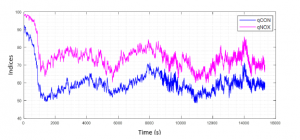
Figure 1: Mean qCON and qNOX for all volunteers from 15 minutes before loss of consciousness (qCON=60) until 4 hours after.
band, and an increase in high frequencies as Beta and Gamma bands. Previous studies [4, 5] have proposed to use EEG monitoring devices to measure also the natural sleep further than using them only for anesthesia assessment. In this work we analyzed the behavior of the anesthesia monitor Conox (Fresenius Kabi, Bad Homburg, Germany), during natural sleep.
2. Methods
In order to obtain the evolution of both anesthesia indexes during natural sleep, 10 volunteers were accepted for this study and agreed to be connected to a Conox device during one night sleep. Signal registration started a few moments before the subject falling asleep and lasted for at least six hours. As an indicator for unconsciousness, the same threshold as in clinical practice during a surgery was used, being a qCON value of 60. A Mann-Whitney U test and also a paired Wilcoxon test were performed in order to analyze if there was significant difference between the two indices. Instants of both indices falling below different thresholds (90, 80, 70 and 60) were also computed in order to know the time decay of each index when the subjects are losing consciousness.
From the EEG signal recorded we analyzed the spectrum in five frequency bands: Delta (0.5 – 4 Hz), Theta (4.5 – 8 Hz), Alpha (8.5 – 13.5 Hz), Beta 1 (14 – 20 Hz) and Beta 2 (20.5 – 30 Hz). Beta energy has been divided in two separate ranges for a better differentiation of the behavior of each frequency since the whole Beta range is very wide. The energy was calculated applying the Fast Fourier Transform (FFT) on 2-seconds EEG windows with overlap of 1 second. The FFT was normalized by the energy contained between the 0.5 and 30 Hz range. A 60 samples moving average smoothing filter was applied for a better visualization of the results, and the mean value of each frequency band was calculated during awake and asleep stages. It was considered that patients were awake when the qCON value was above 60, and asleep otherwise. To determine if there were significant differences between the values of the frequency bands between sleep and awake stages, a Wilcoxon signed rank test was used, at significance level of 0.05.
Taking into consideration the variation of energy in high and low frequencies, to distinguish between REM and NREM stages, we proposed an adaptive threshold for Delta and Beta 2 energy based on a preliminary data analysis which indicated that these frequency bands are the most affected by the transition between sleep stages. Delta threshold is calculated as the 80 % of the difference between maximum and mean energy values during the last 3600 seconds of recording. Beta 2 threshold is calculated as the 80 % of the difference between mean and minimum energy values during the last 3600 seconds of recording. We considered that a REM interval was detected when Delta energy was below the threshold and Beta 2 energy was above it, short intervals being less than 5 minutes were not considered.

Figure 2: Boxplots of Beta 1 (above) and Beta 2 (below) bands during awake (qCON ≥ 60) and asleep (qCON < 60) stages. On each box, the central mark is the median, the edges of the box are the 25th and 75th percentiles. The outliers are marked with a +.
We studied the values of qCON and qNOX during the REM and NREM stages previously identified, and we performed a Wilcoxon signed rank test, at significance level of 0.05, for comparison of the indices.
Table 1: Column 1 shows the mean value ± standard deviation of the qCON for each volunteer when below 60 and column 2 shows the corresponding mean value of qNOX when qCON is below 60. The last column shows the difference between the mean values of qCON and qNOX. The last row indicates the mean and the standard deviation for all volunteers, where qNOX has significantly higher values as compared with qCON. (*p-value = 0.002)
Table 2: Difference of time decay between qCON and qNOX to reach thresholds during the first loss of consciousness (N.A: not available due to qNOX always above the threshold).
3. Results
In Figure 1, average indices values across volunteers are shown and it can be observed that nociception (qNOX index) stays higher than consciousness (qCON index) during sleep. The differences between the two indices were statistically significant (p-value < 0.05,
Mann-Whitney U test). In Table 1 mean values of both indexes are compared when qCON is below 60 for every subject. Results confirm that qNOX was higher for all patients than qCON (p-value < 0.05, Wilcoxon paired test). Table 2 includes the differences of time decay between indexes, showing that qNOX takes more time to fall under all thresholds set than qCON, and in some case never decreases under those values.
The spectrum analysis of the EEG showed that the energy in the low frequency bands Delta, Theta and Alpha present no significant differences between awake and asleep stages (p-values > 0.05, Wilcoxon signed rank test). On the contrary, the energy from Beta 1 and Beta 2 did have significant differences and showed on average higher values while the volunteers were awake (Table 3). The difference in energy value of these bands for both stages can also be observed in Figure 2.
In Figure 3 we can observe the transition between NREM and REM intervals after applying the adaptive thresholds designed. It can be observed that these transitions occurred with certain periodicity during all recording.
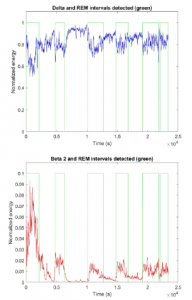
Figure 3: Delta (above) and Beta 2 (below) energy from one subject. The transition between REM and NREM, which corresponds with the moment where the value of Delta and Beta 2 pass their respective thresholds, is represented with the green line.
Table 3: Mean ± standard deviation values of the five selected EEG frequency bands for the periods where the subjects are awake and when they are asleep. P-value is obtained from a Wilcoxon signed rank test, at significance level of 0.05.
Table 4: Mean values of qCON during REM and NREM stages for each volunteer and Wilcoxon signed rank test between both sleep stages revealing statistically significant differences (p < 0.05).
Table 5: Mean values of qNOX during REM and NREM stages for each volunteer and Wilcoxon signed rank test, no significant differences were obtained (p > 0.05).
The results regarding the qCON and the qNOX values during the REM and NREM stages, previously delimited with the thresholds, showed significant differences in qCON values between stages (pvalue < 0.05, Wilcoxon signed rank test), which was not observed in qNOX values, as shown in Table 4 and Table 5 respectively. In the boxplot of Figure 4 there is a representation of the differences in the qCON values for REM and NREM.

Figure 4: Boxplot containing the values of the qCON index during the sections of NREM and REM of night sleep. On each box, the central mark is the median, the edges of the box are the 25th and 75th percentiles. The outliers are marked with a +.
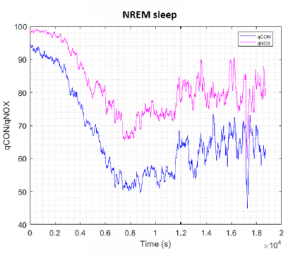
Figure 5: Mean qCON and qNOX for all volunteers during NREM interval. The indices have been aligned at the beginning of NREM interval of each subject.
The trends of the mean qCON and qNOX values for NREM and REM are shown in Figure 5 and Figure 6 respectively. The data of the volunteers has been aligned at the beginning of the REM interval that was around 5000 seconds for all cases. It can be noted from Figure 5 that in NREM sleep qCON and qNOX decrease until the minimum in the first part of the recording and then slightly increase in the last part, showing more variability. During REM sleep (Figure 6) qCON and qNOX time evolution decreases in the first part of the recording to a stable value that is maintained until the last part, where the index values are lower.
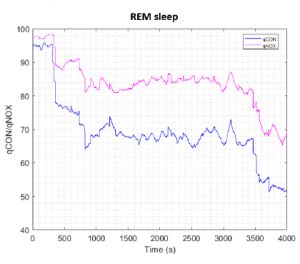
Figure 6: Mean qCON and qNOX for all volunteers during REM interval. The indices have been aligned at the beginning of REM interval of each subject.
4. Discussion
In this study it was found that qCON and qNOX indices behave differently during general anesthesia than compared to natural sleep. During anesthesia, anesthetic and analgesic agents are administrated to reduce both consciousness and nociception levels [6], whereas during night sleep, loss of consciousness is not accompanied by a similar nociception reduction.
Literature suggests that an increase in the energy of Beta is correlated with arousal during sleep [7], as higher values in this band are associated with an awake state. The increases in Beta during sleep found in this study could be related with sympathetic overactivity, which is associated with fragmented sleep [7].
Different NREM and REM sleep stages during natural sleep are characterized by changes in energy distribution in the frequency domain of EEG such as slow (Delta) and fast (Beta 2) oscillation patterns and also other physiological parameters. Indeed, in medical practice, polysomnography is considered the gold standard in sleep analysis because it takes into account several physiological signals such as electrooculogram (EOG) to identify rapid eye movements and electromyogram (EMG) to detect lack of muscular tone, which are characteristic physiological parameters of REM sleep [8]. Conox monitor performance is based on the processing of the EEG, hence it does not take into consideration as many parameters as a polysomnography. Despite that, from the results obtained in this study, qCON index has been able to correctly identify REM intervals
Other studies have been performed about depth of anesthesia monitors being used to monitor sleep since they provide real time EEG data that may be of some value for assessing sleep. A study performed with Sedline monitor (Masimo, Irvine CA) showed higher values during awake and the first parts of the sleep recording, as entering into deeper sleep stages the index of the monitor decreased considerably [5]. From the results obtained with the Conox it has been observed this same tendency, higher qCON values when awake and a decrease as the subject falls asleep. Nevertheless, qCON showed an increase during REM intervals, whereas the Sedline index continued at low values. Another sleep study performed with Bis Vista (Covidien, CO, USA) showed similar results than qCON during REM stage, with a mean (SD) BIS value of 75 (10) [9]. The mean (SD) value of qCON during REM interval was 64.81 (12.09), it is possible to differentiate this interval from an awake state where qCON values are higher.
In regard with nociception, qNOX index showed higher values during sleep than those observed in general anesthesia. Since qNOX index decreases with the administration of analgesic drugs, it could be expected to obtain higher values during sleep than in surgical procedures, where no analgesics are involved.
5. Conclusions
Analysis presented here allows to conclude that natural sleep is characterized by a reduction in consciousness which can fit into ranges similar to general anesthesia, especially during NREM sleep (qCON below 60), but that nociception (qNOX index) tends to remain higher, revealing that an asleep person can still respond to external painful stimuli. It has also been observed that when the subject is losing consciousness, the nociception index decreases slower than the consciousness index.
When studying the energy of the different EEG frequency bands, no significant differences were encountered in the low frequencies between the awake and asleep periods. Nevertheless, higher frequencies did show an increase in their energy when the subjects are awake.
By analyzing time series of energy contained in Delta and Beta 2 bands, one can identify cycles during night sleep. After studying qCON and qNOX indices evolution during these cycles, it can be concluded that qCON has greater values in REM intervals, whereas qNOX does not show significant differences between sleep stages. The significant differences of qCON values between NREM and REM cycles suggest that this index can also be used to differentiate these two stages of night sleep. The Conox monitor does not consider as many sleep parameters as the gold standard, polysomnography. Nevertheless, the present investigation is a preliminary study that might open the gate to use depth of anesthesia devices as Conox to monitor sleep, since it has proven to be able to detect the different sleep cycles by processing the energy of the EEG bands.
For future studies it would be interesting to consider a wider sample of patients, including some subjects with sleep disorders to observe differences in the results against healthy patients.
Conflict of Interest
The authors of this work Joana Canellas, Juan˜ Felipe Ortega, Umberto Melia, Carmen Gonzalez and Erik Weber´ Jensen are employees of Quantium Medical. Quantium Medical is the commercial developer of the indices qCON and qNOX.
- A. Espinoso, J. Can˜ellas, U. Melia, P. Gambu´s, C. Gonza´lez, E. Jensen, “Study of the evolution of the anaesthesia indices qCON and qNOX during natural sleep,” in 2020 11th Conference of the European Study Group on Cardiovascular Oscillations (ESGCO), 1–2, IEEE, 2020.
- S. Chokroverty, et al., “Overview of sleep & sleep disorders,” Indian J Med Res,
131(2), 126–140, 2010. - R. Ferri, F. I. Cosentino, M. Elia, S. A. Musumeci, R. Marinig, P. Bergonzi, “Re- lationship between Delta, Sigma, Beta, and Gamma EEG bands at REM sleep onset and REM sleep end,” Clinical Neurophysiology, 112(11), 2046–2052, 2001.
- C. McPherson, K. Behbehani, D. Dao, J. Burk, E. Lucas, “Characterization of sleep using bispectral analysis,” in 2001 Conference Proceedings of the 23rd Annual International Conference of the IEEE Engineering in Medicine and Biology Society, volume 3, 2216–2219, IEEE, 2001.
- C. Kapp, N. Punjabi, “Using a Sedation Monitor to Assess Sleep,” in B65. SRN: DIAGNOSIS AND MONITORING OF SLEEP AND SLEEP DISORDERS, A3884–A3884, American Thoracic Society, 2019.
- E. Jensen, J. Valencia, A. Lo´pez, T. Anglada, M. Agust´i, Y. Ramos, R. Serra, M. Jospin, P. Pineda, P. Gambus, “Monitoring hypnotic effect and nociception with two EEG-derived indices, qCON and qNOX, during general anaesthesia,” Acta Anaesthesiologica Scandinavica, 58(8), 933–941, 2014.
- T. B. Kuo, C.-Y. Chen, Y.-C. Hsu, C. C. Yang, “EEG beta power and heart rate variability describe the association between cortical and autonomic arousals across sleep,” Autonomic Neuroscience, 194, 32–37, 2016.
- “Polysomnography: Overview, Parameters Monitored, Staging of Sleep.” Available: https://emedicine.medscape.com/article/ 1188764-overview#a2 (visited on 18-12-2020).
- M.R. Benissa, S. Khirani, S. Hartley, A. Adala, A. Ramirez, M. Fernandez- Bolanos, M.-A. Quera-Salva, B. Fauroux, “Utility of the bispectral index for assessing natural physiological sleep stages in children and young adults,” Journal computing, 30(6), 957–963, 2016.
- Fahmina Taranum, Sadaf Kauser, Maniza Hijab, Gouri R Patil, Syeda Fouzia Sayeedunissa, "Beyond Fitness: Revolutionary Exercise Tracker Combining Pose Recognition with Heart Rate Monitoring using Remote Photoplethysmography (rPPG)", Advances in Science, Technology and Engineering Systems Journal, vol. 11, no. 1, pp. 33–43, 2026. doi: 10.25046/aj110104
- Marlene Böhmer, Thorsten Herfet, "PerfVis+: From Timestamps to Insight through Integration of Visual and Statistical Analysis", Advances in Science, Technology and Engineering Systems Journal, vol. 10, no. 6, pp. 77–87, 2025. doi: 10.25046/aj100607
- Sarawuth Pramualsingha, Kazuo Yamamoto, RikutoTanaka, "Lightning Detection System for Wind Turbines Using a Large-Diameter Rogowski Coil", Advances in Science, Technology and Engineering Systems Journal, vol. 10, no. 1, pp. 1–6, 2025. doi: 10.25046/aj100101
- Le Truong Vinh Phuc, Mituteru Nakamura, Masakazu Higuchi, Shinichi Tokuno, "Effectiveness of a voice analysis technique in the assessment of depression status of individuals from Ho Chi Minh City, Viet Nam: A cross-sectional study", Advances in Science, Technology and Engineering Systems Journal, vol. 9, no. 4, pp. 73–78, 2024. doi: 10.25046/aj090408
- Maximo Giovani Tandazo Espinoza, "Comparing Kalman Filter and Diffuse Kalman Filter on a GPS Signal with Noise", Advances in Science, Technology and Engineering Systems Journal, vol. 9, no. 1, pp. 124–132, 2024. doi: 10.25046/aj090112
- Yutaka Yoshida, Emi Yuda, "Verify of Left and Right Differences in Sleep Index using the Ring-type Sensor", Advances in Science, Technology and Engineering Systems Journal, vol. 9, no. 1, pp. 9–14, 2024. doi: 10.25046/aj090102
- Jong-Hwa Yoon, Dal-Hwan Yoon, "Implementation of a GAS Injection Type Prefabricated Lifting Device for Underwater Rescue Based on Location Tracking", Advances in Science, Technology and Engineering Systems Journal, vol. 8, no. 6, pp. 78–86, 2023. doi: 10.25046/aj080609
- Nizar Sakli, Chokri Baccouch, Hedia Bellali, Ahmed Zouinkhi, Mustapha Najjari, "IoT System and Deep Learning Model to Predict Cardiovascular Disease Based on ECG Signal", Advances in Science, Technology and Engineering Systems Journal, vol. 8, no. 6, pp. 08–18, 2023. doi: 10.25046/aj080602
- Eilin Gómez Mesino, Joaquín Caicedo, Miguel Mamaní, David Romero Quete, Andrés Cerón Piamba, Diego García Gómez, Guillermo Aponte Mayor, José Caicedo Erazo, Wilmar Moreno López, Edward Jay, Andrés Romero Quete, "Condition Assessment of Medium Voltage Assets: A Review", Advances in Science, Technology and Engineering Systems Journal, vol. 8, no. 5, pp. 35–54, 2023. doi: 10.25046/aj080505
- Faraz Talebpour, Saeed Mozaffari, Mehrdad Saif, Shahpour Alirezaee, "Localization of Impulsive Sound Source in ShallowWaters using a Selective Modal Analysis Algorithm", Advances in Science, Technology and Engineering Systems Journal, vol. 8, no. 4, pp. 18–27, 2023. doi: 10.25046/aj080403
- Christoph Domnik, Daniel Erni, Christoph Degen, "Measurement System for Evaluation of Radar Algorithms using Replication of Vital Sign Micro Movement and Dynamic Clutter", Advances in Science, Technology and Engineering Systems Journal, vol. 8, no. 3, pp. 29–39, 2023. doi: 10.25046/aj080304
- Ivana Marin, Sven Gotovac, Vladan Papić, "Development and Analysis of Models for Detection of Olive Trees", Advances in Science, Technology and Engineering Systems Journal, vol. 8, no. 2, pp. 87–96, 2023. doi: 10.25046/aj080210
- Jin Uk Yeon, Ji Whan Noh, Innyeal Oh, "Temperature-Compensated Overcharge Protection Measurement Technology", Advances in Science, Technology and Engineering Systems Journal, vol. 8, no. 2, pp. 24–29, 2023. doi: 10.25046/aj080203
- Sathyabama Kaliyapillai, Saruladha Krishnamurthy, Thiagarajan Murugasamy, "An Ensemble of Voting- based Deep Learning Models with Regularization Functions for Sleep Stage Classification", Advances in Science, Technology and Engineering Systems Journal, vol. 8, no. 1, pp. 84–94, 2023. doi: 10.25046/aj080110
- Luís Cláudio Dallier Saldanha, "A Review of the Role of Information Technology in Brazilian Higher Educational Institutions during Covid-19 Pandemic", Advances in Science, Technology and Engineering Systems Journal, vol. 7, no. 6, pp. 189–194, 2022. doi: 10.25046/aj070620
- Gianvito Mitrano, Antonio Caforio, Tobia Calogiuri, Chiara Colucci, Luca Mainetti, Roberto Paiano, Claudio Pascarelli, "A Cloud Telemedicine Platform Based on Workflow Management System: A Review of an Italian Case Study", Advances in Science, Technology and Engineering Systems Journal, vol. 7, no. 6, pp. 87–102, 2022. doi: 10.25046/aj070610
- Brahim Zraibi, Mohamed Mansouri, Salah Eddine Loukili, Said Ben Alla, "Hybrid Neural Network Method for Predicting the SOH and RUL of Lithium-Ion Batteries", Advances in Science, Technology and Engineering Systems Journal, vol. 7, no. 5, pp. 193–198, 2022. doi: 10.25046/aj070520
- Hiroaki Hanai, Akira Mishima, Atsuyuki Miura, Toshiki Hirogaki, Eiichi Aoyama, "Realization of Skillful Musical Saw Bowing by Industrial Collaborative Humanoid Robot", Advances in Science, Technology and Engineering Systems Journal, vol. 7, no. 5, pp. 1–9, 2022. doi: 10.25046/aj070501
- Ahmed Abdelaziz Elsayed, Mohamed Ahmed Abdellah, Mansour Ahmed Mohamed, Mohamed Abd Elazim Nayel, "µPMU Hardware and Software Design Consideration and Implementation for Distribution Grid Applications", Advances in Science, Technology and Engineering Systems Journal, vol. 7, no. 4, pp. 59–71, 2022. doi: 10.25046/aj070409
- Heidi Fleischer, Sascha Statkevych, Janne Widmer, Regina Stoll, Thomas Roddelkopf, Kerstin Thurow, "Automated Robotic System for Sample Preparation and Measurement of Heavy Metals in Indoor Dust Using Inductively Coupled Plasma Mass Spectrometry (ICP-MS)", Advances in Science, Technology and Engineering Systems Journal, vol. 7, no. 3, pp. 139–151, 2022. doi: 10.25046/aj070316
- Aicha Lamjahdi, Hafida Bouloiz, Maryam Gallab, "Heuristic Analysis of Overall Performance Measurement Perception and Management in Automotive Industry", Advances in Science, Technology and Engineering Systems Journal, vol. 7, no. 3, pp. 1–11, 2022. doi: 10.25046/aj070301
- Mitsuru Kawamoto, Takuji Hamamoto, "Building Health Monitoring using Visualization of Sound Features Based on Sound Localization", Advances in Science, Technology and Engineering Systems Journal, vol. 6, no. 6, pp. 01–06, 2021. doi: 10.25046/aj060601
- Toshiki Watanabe, Hiroyuki Kameda, "Designing a Model of Consciousness Based on the Findings of Jungian Psychology", Advances in Science, Technology and Engineering Systems Journal, vol. 6, no. 5, pp. 356–361, 2021. doi: 10.25046/aj060540
- Boris Kontsevoi, Sergei Terekhov, "TETRA™ Techniques to Assess and Manage the Software Technical Debt", Advances in Science, Technology and Engineering Systems Journal, vol. 6, no. 5, pp. 303–309, 2021. doi: 10.25046/aj060534
- Jotje Rantung, Frans Palobo Sappu, Yan Tondok, "Real-time Measurement Method for Fish Surface Area and Volume Based on Stereo Vision", Advances in Science, Technology and Engineering Systems Journal, vol. 6, no. 5, pp. 141–148, 2021. doi: 10.25046/aj060516
- Mila Ilieva-Obretenova, "Devices and Methods for Microclimate Research in Closed Areas – Underground Mining", Advances in Science, Technology and Engineering Systems Journal, vol. 6, no. 4, pp. 395–400, 2021. doi: 10.25046/aj060444
- Kumar Rahul Tiwari, Indar Singhal, Alok Mittal, "Real Time RSSI Compensation for Precise Distance Calculation using Sensor Fusion for Smart Wearables", Advances in Science, Technology and Engineering Systems Journal, vol. 6, no. 4, pp. 327–333, 2021. doi: 10.25046/aj060436
- Jose María Sierra-Fernández, Agustin Agüera-Pérez, Jose Carlos Palomares-Salas, Manuel Jesús Espinosa-Gavira, Olivia Florancias-Oliveros, Juan José González de la Rosa, "Web-based Remote Lab System for Instrumentation and Electronic Learning", Advances in Science, Technology and Engineering Systems Journal, vol. 6, no. 4, pp. 100–109, 2021. doi: 10.25046/aj060412
- Antonio Casquero Jiménez, Jorge Pérez Martínez, "Remote Patient Monitoring Systems with 5G Networks", Advances in Science, Technology and Engineering Systems Journal, vol. 6, no. 4, pp. 44–51, 2021. doi: 10.25046/aj060406
- Mitsumasa Hida, Ayuna Hasegawa, Sachiyo Kamitani, Yumi Kamitani, Kodai Kitagawa, Shogo Okamatsu, Tadasuke Ohnishi, Seigo Minami, Chikamune Wada, "Coronal Spinal Postural Alignment Screening Tool using Markerless Digital Photography", Advances in Science, Technology and Engineering Systems Journal, vol. 6, no. 2, pp. 965–970, 2021. doi: 10.25046/aj0602110
- Binghan Li, Yindong Hua, Mi Lu, "Advanced Multiple Linear Regression Based Dark Channel Prior Applied on Dehazing Image and Generating Synthetic Haze", Advances in Science, Technology and Engineering Systems Journal, vol. 6, no. 2, pp. 790–800, 2021. doi: 10.25046/aj060291
- Dancan Otieno Onyango, Christopher Ogolo Ikporukpo, John Olalekan Taiwo, Stephen Balaka Opiyo, Kevin Okoth Otieno, "Comparative Analysis of Land Use/Land Cover Change and Watershed Urbanization in the Lakeside Counties of the Kenyan Lake Victoria Basin Using Remote Sensing and GIS Techniques", Advances in Science, Technology and Engineering Systems Journal, vol. 6, no. 2, pp. 671–688, 2021. doi: 10.25046/aj060278
- Rajani Narayan, Anjanappa Sreenivasa Murthy, "Texture Based Image Retrieval Using Semivariogram and Various Distance Measures", Advances in Science, Technology and Engineering Systems Journal, vol. 6, no. 1, pp. 1369–1377, 2021. doi: 10.25046/aj0601156
- Saliha Assoul, Anass Rabii, Ounsa Roudiès, "An Operational Responsibility and Task Monitoring Method: A Data Breach Case Study", Advances in Science, Technology and Engineering Systems Journal, vol. 6, no. 1, pp. 1157–1163, 2021. doi: 10.25046/aj0601130
- Yashvant Bhavsar, Saurabh Pandya, "Allocation of Total Congestion Cost and load participation to Generators for a PoolCo Market in Deregulated Power System", Advances in Science, Technology and Engineering Systems Journal, vol. 6, no. 1, pp. 1145–1150, 2021. doi: 10.25046/aj0601128
- Walvies Mc. Alcos, Mirador G. Labrador, "A Surface Plasmon Resonance (SPR) and Water Quality Monitoring: A System for Detecting Harmful Algal Bloom", Advances in Science, Technology and Engineering Systems Journal, vol. 6, no. 1, pp. 770–775, 2021. doi: 10.25046/aj060185
- Ademola Abdulkareem, Divine Ogbe, Tobiloba Somefun, Felix Agbetuyi, "Optimal PMU Placement Using Genetic Algorithm for 330kV 52-Bus Nigerian Network", Advances in Science, Technology and Engineering Systems Journal, vol. 6, no. 1, pp. 597–604, 2021. doi: 10.25046/aj060164
- Fang-Lin Chao, Wei Zhong Feng, Kaiquan Shi, "Smart Collar and Chest Strap Design for Rescue Dog through Multidisciplinary Approach", Advances in Science, Technology and Engineering Systems Journal, vol. 6, no. 1, pp. 386–392, 2021. doi: 10.25046/aj060144
- Vítor Viegas, J. M. Dias Pereira, Pedro Girão, Octavian Postolache, "Study of latencies in ThingSpeak", Advances in Science, Technology and Engineering Systems Journal, vol. 6, no. 1, pp. 342–348, 2021. doi: 10.25046/aj060139
- Wilfredo Carcausto, Juan Morales, María Patricia Cucho-Leyva, Noel Alcas-Zapata, Mirella Patricia Villena-Guerrero, "Distance Teaching-Learning Experience in Early Childhood Education Teachers During the Coronavirus Pandemic", Advances in Science, Technology and Engineering Systems Journal, vol. 6, no. 1, pp. 269–274, 2021. doi: 10.25046/aj060131
- Abdellatif Elouali, Smail Hafidi Alaoui, Noura Ettahir, Abderrazzak Khohmimidi, Nadia Motii, Keltoum Rahali, Mustapha Kouzer, "Touristic’s Destination Brand Image: Proposition of a Measurement Scale for Rabat City (Morocco)", Advances in Science, Technology and Engineering Systems Journal, vol. 5, no. 6, pp. 1750–1758, 2020. doi: 10.25046/aj0506209
- Yaswanthkumar S K, Keerthana M, Vishnu Prasath M S, "A Machine Vision Approach for Underwater Remote Operated Vehicle to Detect Drowning Humans", Advances in Science, Technology and Engineering Systems Journal, vol. 5, no. 6, pp. 1734–1740, 2020. doi: 10.25046/aj0506207
- Abba Suganda Girsang, Sani Muhamad Isa, Natasya, Megga Eunike Cristilia Ginzel, "Implementation of a Journalist Business Intelligence in Social Media Monitoring System", Advances in Science, Technology and Engineering Systems Journal, vol. 5, no. 6, pp. 1517–1528, 2020. doi: 10.25046/aj0506182
- Ryosuke Sakakibara, Yasuhiro Shindo, Kazuo Kato, Pak Kon Choi, Akira Takeuchi, "Basic Study of 3-D Non-Invasive Measurement of Temperature Distribution using Ultrasound Images during HIFU Heating", Advances in Science, Technology and Engineering Systems Journal, vol. 5, no. 6, pp. 1306–1311, 2020. doi: 10.25046/aj0506155
- Aicha Ousrhire, Hassane Oulidi Jarar, Abdessamad Ghafiri, "Multi-Criteria Decision Analysis Coupled with GIS and Remote Sensing Techniques for Delineating Suitable Artificial Aquifer Recharge Sites in Tafilalet Plain (Morocco)", Advances in Science, Technology and Engineering Systems Journal, vol. 5, no. 6, pp. 1109–1124, 2020. doi: 10.25046/aj0506135
- Anatoly Panyukov, Alexander Bogushov, "Development of Secondary Processing Data Methods under Single Point Thunderstorm Activity Monitoring", Advances in Science, Technology and Engineering Systems Journal, vol. 5, no. 6, pp. 1096–1102, 2020. doi: 10.25046/aj0506133
- Ademola Abdulkareem, Divine Ogbe, Tobiloba Somefun, "Review of Different Methods for Optimal Placement of Phasor Measurement Unit on the Power System Network", Advances in Science, Technology and Engineering Systems Journal, vol. 5, no. 6, pp. 1071–1081, 2020. doi: 10.25046/aj0506130
- Carlos M. Oppus, Maria Aileen Leah G. Guzman, Maria Leonora C. Guico, Jose Claro N. Monje, Mark Glenn F. Retirado, John Chris T. Kwong, Genevieve C. Ngo, Annael J. Domingo, "Design of a Remote Real-time Groundwater Level and Water Quality Monitoring System for the Philippine Groundwater Management Plan Project", Advances in Science, Technology and Engineering Systems Journal, vol. 5, no. 6, pp. 1007–1012, 2020. doi: 10.25046/aj0506121
- Alan Guadalupe Ochoa Navarro, Juan De Dios Cota Apodaca, Dario Fuentes Guevara, "Strategic Plan for the Achievement of the Competitiveness of Small Companies with Respect to Large Ones", Advances in Science, Technology and Engineering Systems Journal, vol. 5, no. 6, pp. 584–587, 2020. doi: 10.25046/aj050671
- Felix Fernandez-Pena, Alex Maigua-Quinteros, Pilar Urrutia-Urrutia, Diana Coello-Fiallos, "Ontology-based Data Management Tool for Studying Radon Concentration", Advances in Science, Technology and Engineering Systems Journal, vol. 5, no. 6, pp. 577–583, 2020. doi: 10.25046/aj050670
- Paul Cabacungan, Carlos Oppus, Gregory Tangonan, Nerissa Cabacungan, John Paul Mamaradlo, Neil Angelo Mercado, "Design and Development of Electronic Sensor and Monitoring System of Smart Low-cost Phototherapy Light System for Non-Invasive Monitoring and Treatment of Neonatal Jaundice", Advances in Science, Technology and Engineering Systems Journal, vol. 5, no. 5, pp. 1233–1246, 2020. doi: 10.25046/aj0505149
- Takuya Sarugaku, Jun Lee, Yasuaki Matsumoto, Mitsuho Yamada, "Examination of a Skill Sampling Method of an Athlete Using the Athlete’s Movement and Eye Movement for the Development of an AI Coach", Advances in Science, Technology and Engineering Systems Journal, vol. 5, no. 5, pp. 1204–1213, 2020. doi: 10.25046/aj0505146
- Hasn Mahmood Khudair, Taif Alawsi, Anwaar A. Aldergazly, A. H. Majeed, "Design and Implementation of Aerial Vehicle Remote Sensing and Surveillance System, Dehazing Technique Using Modified Dark Channel Prior", Advances in Science, Technology and Engineering Systems Journal, vol. 5, no. 5, pp. 1111–1117, 2020. doi: 10.25046/aj0505135
- Ghada Ben Salah, Karim Abbes, Chokri Abdelmoula, Mohamed Masmoudi, "Design of High Output Impedance, Large Voltage Compliance Output Stage of Implantable Hypoglossal Nerve Stimulator (HGNS) for OSA Treatment", Advances in Science, Technology and Engineering Systems Journal, vol. 5, no. 5, pp. 852–863, 2020. doi: 10.25046/aj0505104
- Tri Nhut Do, Quang Minh Pham, Hoa Binh Le-Nguyen, Cao Tri Nguyen, Hai Minh Nguyen-Tran, "Development of a Wireless Displacement Estimation System Using IMU-based Device", Advances in Science, Technology and Engineering Systems Journal, vol. 5, no. 5, pp. 781–788, 2020. doi: 10.25046/aj050595
- Khalid A. AlAfandy, Hicham Omara, Mohamed Lazaar, Mohammed Al Achhab, "Using Classic Networks for Classifying Remote Sensing Images: Comparative Study", Advances in Science, Technology and Engineering Systems Journal, vol. 5, no. 5, pp. 770–780, 2020. doi: 10.25046/aj050594
- Khalid A. AlAfandy, Hicham, Mohamed Lazaar, Mohammed Al Achhab, "Investment of Classic Deep CNNs and SVM for Classifying Remote Sensing Images", Advances in Science, Technology and Engineering Systems Journal, vol. 5, no. 5, pp. 652–659, 2020. doi: 10.25046/aj050580
- Mimi Mohaffyza Mohamad, Alias Masek, Jailani Md Yunos, Maizam Alias, Nor Hidayah Hamdan, Andika Bagus Nur Rahma Putra, "Assessing Heutagogical Elements in Learning of Engineering Education: Instrument Validation", Advances in Science, Technology and Engineering Systems Journal, vol. 5, no. 5, pp. 245–252, 2020. doi: 10.25046/aj050530
- Young-Jin Park, Hui-Sup Cho, "A Method for Detecting Human Presence and Movement Using Impulse Radar", Advances in Science, Technology and Engineering Systems Journal, vol. 5, no. 4, pp. 770–775, 2020. doi: 10.25046/aj050491
- Panida Lorwongtrakool, Phayung Meesad, "Correlation-Based Incremental Learning Network for Gas Sensors Drift Compensation Classification", Advances in Science, Technology and Engineering Systems Journal, vol. 5, no. 4, pp. 660–666, 2020. doi: 10.25046/aj050479
- Marco Bindi, Igor Aizenberg, Riccardo Belardi, Francesco Grasso, Antonio Luchetta, Stefano Manetti, Maria Cristina Piccirilli, "Neural Network-Based Fault Diagnosis of Joints in High Voltage Electrical Lines", Advances in Science, Technology and Engineering Systems Journal, vol. 5, no. 4, pp. 488–498, 2020. doi: 10.25046/aj050458
- Pratik Kumar Singh, Fadillah Binti Ismail, Chan Shiau Wei, Muhammad Imran, Syed Ashfaq Ahmed, "A Framework of E-Procurement Technology for Sustainable Procurement in ISO 14001 Certified Firms in Malaysia", Advances in Science, Technology and Engineering Systems Journal, vol. 5, no. 4, pp. 424–431, 2020. doi: 10.25046/aj050450
- Sarun Duangsuwan, Chakree Teekapakvisit, Myo Myint Maw, "Development of Soil Moisture Monitoring by using IoT and UAV-SC for Smart Farming Application", Advances in Science, Technology and Engineering Systems Journal, vol. 5, no. 4, pp. 381–387, 2020. doi: 10.25046/aj050444
- Andry Alamsyah, Sri Widiyanesti, Rizqy Dwi Putra, Puspita Kencana Sari, "Personality Measurement Design for Ontology Based Platform using Social Media Text", Advances in Science, Technology and Engineering Systems Journal, vol. 5, no. 3, pp. 100–107, 2020. doi: 10.25046/aj050313
- Kapil Kumar Gupta, Namrata Dhanda, Upendra Kumar, "A Novel Hybrid Method for Segmentation and Analysis of Brain MRI for Tumor Diagnosis", Advances in Science, Technology and Engineering Systems Journal, vol. 5, no. 3, pp. 16–27, 2020. doi: 10.25046/aj050303
- Tan Ming Hui, Ahmad Yusairi Bani Hashim, "Evaluation of Uncertainty Measurement Calculation for Vector Network Analyzer From 300 kHz to 8.5 GHz", Advances in Science, Technology and Engineering Systems Journal, vol. 5, no. 3, pp. 01–10, 2020. doi: 10.25046/aj050301
- Gede Indrawan, I Made Agus Oka Gunawan, Sariyasa, "The Usability Evaluation of Academic Progress Information System (SIsKA-NG)", Advances in Science, Technology and Engineering Systems Journal, vol. 5, no. 2, pp. 460–468, 2020. doi: 10.25046/aj050259
- Sourav Sinha, Ta-Seen Reaz Niloy, Raja Rashidul Hasan, Md. Abdur Rahman, "In Body Antenna for Monitoring and Controlling Pacemaker", Advances in Science, Technology and Engineering Systems Journal, vol. 5, no. 2, pp. 74–79, 2020. doi: 10.25046/aj050209
- Daniel Arteaga, Guillermo Kemper, Samuel G. Huaman Bustamante, Joel Telles, Leon Bendayan, Jose Sanjurjo, "A Method for Mosaicking Aerial Images based on Flight Trajectory and the Calculation of Symmetric Transfer Error per Inlier", Advances in Science, Technology and Engineering Systems Journal, vol. 4, no. 6, pp. 328–338, 2019. doi: 10.25046/aj040642
- Devulapalli Sudheer, Rajakumar Krishnan, "Multiscale Texture Analysis and Color Coherence Vector Based Feature Descriptor for Multispectral Image Retrieval", Advances in Science, Technology and Engineering Systems Journal, vol. 4, no. 6, pp. 270–279, 2019. doi: 10.25046/aj040634
- Youssef Bikrat, Khalid Salmi, Kamal Azghiou, Ahmad Benlghazi, Abdelhamid Benali, and Driss Moussaid, "Intelligent Wireless System for PV Supervision Based on The Raspberry Pi", Advances in Science, Technology and Engineering Systems Journal, vol. 4, no. 6, pp. 94–98, 2019. doi: 10.25046/aj040611
- Seema Saxena, Vikramjeet Singh, Rajesh Kumar Gupta, Nitin Kumar Mishra, Pushpinder Singh, "Green Inventory Supply Chain Model with Inflation under Permissible Delay in Finite Planning Horizon", Advances in Science, Technology and Engineering Systems Journal, vol. 4, no. 5, pp. 123–131, 2019. doi: 10.25046/aj040516
- Stephen Craig Stubberud, Kathleen Ann Kramer, Allen Roger Stubberud, "Estimation of Target Maneuvers from Tracked Behavior Using Fuzzy Evidence Accrual", Advances in Science, Technology and Engineering Systems Journal, vol. 4, no. 4, pp. 468–477, 2019. doi: 10.25046/aj040457
- Avid Roman-Gonzalez, Antony Ciriaco-Susanibar, Natalia I. Vargas-Cuentas, "Comparing the Scientific Production of Peruvian Universities with Equitable Indexes", Advances in Science, Technology and Engineering Systems Journal, vol. 4, no. 4, pp. 394–403, 2019. doi: 10.25046/aj040448
- Takahiro Ishizu, Makoto Sakamoto, Masamichi Hori, Takahiro Shinoda, Takaaki Toyota, Amane Takei, Takao Ito, "Hidden Surface Removal for Interaction between Hand and Virtual Objects in Augmented Reality", Advances in Science, Technology and Engineering Systems Journal, vol. 4, no. 4, pp. 359–365, 2019. doi: 10.25046/aj040444
- Anang Hudaya Muhamad Amin, Nazrul Muhaimin Ahmad, Subarmaniam Kannan, "Event Monitoring using Distributed Pattern Recognition Approach on Integrated IoT-Blockchain Network", Advances in Science, Technology and Engineering Systems Journal, vol. 4, no. 4, pp. 256–264, 2019. doi: 10.25046/aj040432
- Alexander Vodyaho, Evgeniy Postnikov, Alexander Ekalo, Vasiliy Osipov, Nataly Zhukova, Michael Chervontsev, "Cognitive Systems for Monitoring: Architectural View", Advances in Science, Technology and Engineering Systems Journal, vol. 4, no. 3, pp. 117–125, 2019. doi: 10.25046/aj040316
- Robert M. Beswick, "Computer Security as an Engineering Practice: A System Engineering Discussion", Advances in Science, Technology and Engineering Systems Journal, vol. 4, no. 2, pp. 357–369, 2019. doi: 10.25046/aj040245
- Alexander Vodyaho, Evgeniy Postnikov, Osipov Vasiliy, Nataly Zhukova, Michael Chervontsev, Nikolai Klimov, "Computational and Technological Models of Cognitive Monitoring Systems", Advances in Science, Technology and Engineering Systems Journal, vol. 4, no. 2, pp. 197–202, 2019. doi: 10.25046/aj040226
- Evgenia Kapassa, Marios Touloupou, Panagiotis Stavrianos, Georgios Xylouris, Dimosthenis Kyriazis, "Managing and Optimizing Quality of Service in 5G Environments Across the Complete SLA Lifecycle", Advances in Science, Technology and Engineering Systems Journal, vol. 4, no. 1, pp. 329–342, 2019. doi: 10.25046/aj040132
- Philipp Berlt, Lisa Jäger, Andreas Schwind, Frank Wollenschläger, Christian Bornkessel, Matthias A. Hein, "Over-The-Air Testing of Automotive Antennas and Wireless Links in The Installed State on The Basis of LTE Downlink Communication Parameters", Advances in Science, Technology and Engineering Systems Journal, vol. 4, no. 1, pp. 282–291, 2019. doi: 10.25046/aj040127
- Masahiro Kanazaki, Yusuke Yamada, Masaki Nakamiya, "Multi-Objective Path Optimization of a Satellite for Multiple Active Space Debris Removal Based on a Method for the Travelling Serviceman Problem", Advances in Science, Technology and Engineering Systems Journal, vol. 3, no. 6, pp. 479–488, 2018. doi: 10.25046/aj030656
- Callum Owen-Bridge, Stewart Blakeway, Emanuele Lindo Secco, "An Integrated & Secure System for Wearable Devices", Advances in Science, Technology and Engineering Systems Journal, vol. 3, no. 6, pp. 432–437, 2018. doi: 10.25046/aj030651
- João Manuel Leitão Pires Caldeira, Vasco Nuno da Gama de Jesus Soares, Pedro Miguel de Figueiredo Dinis Oliveira Gaspar, Joel José Puga Coelho Rodrigues, Ricardo Manuel Valentim Fontes, José Luís Lopes Silva, "iSensA – A System for Collecting and Integrating Sensor Data", Advances in Science, Technology and Engineering Systems Journal, vol. 3, no. 6, pp. 213–221, 2018. doi: 10.25046/aj030628
- Satyam Paul, Raheleh Jafari, "Recent Advances in Intelligent-Based Structural Health Monitoring of Civil Structures", Advances in Science, Technology and Engineering Systems Journal, vol. 3, no. 5, pp. 339–353, 2018. doi: 10.25046/aj030540
- Mostafa Haghi, Kerstin Thurow, Regina Stoll, "A Ubiquitous and Configurable Wrist-Worn Sensor Node in Hazardous Gases Detection", Advances in Science, Technology and Engineering Systems Journal, vol. 3, no. 5, pp. 248–257, 2018. doi: 10.25046/aj030530
- Khaled Slhoub, Marco Carvalho, "Towards Process Standardization for Requirements Analysis of Agent-Based Systems", Advances in Science, Technology and Engineering Systems Journal, vol. 3, no. 3, pp. 80–91, 2018. doi: 10.25046/aj030311
- Cheryl Marie Cordeiro, "Which User of technology? Perspectivising the UTAUT model by application of the SFL language Pronoun System towards a systems perspective of technology acceptance and use", Advances in Science, Technology and Engineering Systems Journal, vol. 3, no. 2, pp. 309–318, 2018. doi: 10.25046/aj030234
- Moises Levy, Daniel Raviv, "An Overview of Data Center Metrics and a Novel Approach for a New Family of Metrics", Advances in Science, Technology and Engineering Systems Journal, vol. 3, no. 2, pp. 238–251, 2018. doi: 10.25046/aj030228
- Ajay Poonjal Pai, Tomas Reiter, Oleg Vodyakho, Martin Maerz, "Mission Profile Analysis of a SiC Hybrid Module for Automotive Traction Inverters and its Experimental Power-loss Validation with Electrical and Calorimetric Methods", Advances in Science, Technology and Engineering Systems Journal, vol. 3, no. 1, pp. 329–341, 2018. doi: 10.25046/aj030140
- Cyrille Caironi, Bernhard Fruth, Detlef Hummes, Rudolf Blank, "Influence of supply frequency on dissipation factor measurement and stator insulation diagnosis", Advances in Science, Technology and Engineering Systems Journal, vol. 3, no. 1, pp. 155–159, 2018. doi: 10.25046/aj030119
- Marwa Farouk Ibrahim Ibrahim, Adel Ali Al-Jumaily, "Auto-Encoder based Deep Learning for Surface Electromyography Signal Processing", Advances in Science, Technology and Engineering Systems Journal, vol. 3, no. 1, pp. 94–102, 2018. doi: 10.25046/aj030111
- Solym Mawaki Manou-Abi, William Dimbour, "S-asymptotically w-periodic solutions in the p-th mean for a Stochastic Evolution Equation driven by Q-Brownian motion", Advances in Science, Technology and Engineering Systems Journal, vol. 2, no. 5, pp. 124–133, 2017. doi: 10.25046/aj020519
- V. Vilfred Kamalappan, "A Study on Isomorphic Properties of Circulant Graphs", Advances in Science, Technology and Engineering Systems Journal, vol. 2, no. 6, pp. 236–241, 2017. doi: 10.25046/aj020628
- Oleksandr Poliarus, Yevhen Poliakov, Andrii Lebedynskyi, Viktor Ivanov, Ruslan Pashchenko, "Measurement of the Bridge Surface Deflections Using Near-Field Amplitude of Secondary Radiators System", Advances in Science, Technology and Engineering Systems Journal, vol. 2, no. 6, pp. 217–224, 2017. doi: 10.25046/aj020626
- Weihua Li, Chiman Kwan, "A Novel Approach to Sensor and Actuator Integrity Monitoring and Fault Magnitude Reconstruction", Advances in Science, Technology and Engineering Systems Journal, vol. 2, no. 3, pp. 1748–1757, 2017. doi: 10.25046/aj0203214
- Mbunwe Muncho Josephine, "Design and Construction of a remote control switching device for household appliances application", Advances in Science, Technology and Engineering Systems Journal, vol. 2, no. 4, pp. 154–164, 2017. doi: 10.25046/aj020421
- Moises Levy, Jason O. Hallstrom, "A Reliable, Non-Invasive Approach to Data Center Monitoring and Management", Advances in Science, Technology and Engineering Systems Journal, vol. 2, no. 3, pp. 1577–1584, 2017. doi: 10.25046/aj0203196
- Justin Yuan Shi, Yasin Celik, "Scalability Dilemma and Statistic Multiplexed Computing — A Theory and Experiment", Advances in Science, Technology and Engineering Systems Journal, vol. 2, no. 3, pp. 1453–1460, 2017. doi: 10.25046/aj0203181
- Zoltan Sarkany, Marta Rencz, "A Way for Measuring the Temperature Transients of Capacitors", Advances in Science, Technology and Engineering Systems Journal, vol. 2, no. 3, pp. 1381–1389, 2017. doi: 10.25046/aj0203174