
A Study of the Digital Health Management Needs of the Elderly

Adv. Sci. Technol. Eng. Syst. J. 10(2), 42–48 (2025);
 DOI: 10.25046/aj100205
The purpose of this paper is to explore the feasibility and development trend of utilizing smart medical technology for chronic disease health management in older people in the context of ageing at home. As the ageing society intensifies, the elderly population faces multiple health challenges, especially the management of chronic diseases. This paper analyzes the potential of smart medical technologies, such as remote monitoring, artificial intelligence, and the Internet of Things (IoT), to improve the efficiency and quality of health management for older people. By leveraging Maslow’s Hierarchy of Needs Theory and Fogg’s Behavioral Model, the article explores how to design smart health management products that meet the different health needs of older adults. In addition, the article discusses the barriers that the elderly population may encounter in accepting and using technology, such as the digital divide and technology adaptation issues, and proposes relevant coping strategies. Ultimately, the article concludes that with the continuous development of technology, smart healthcare technology will play an increasingly important role in geriatric health management, helping to improve the health status of older people, enhance their quality of life, and promote the innovation and development of social health management. The research in this paper provides new ideas for designing health management products for older people and supports the design and optimization of intelligent health management services.
1. Introduction
China’s ageing level is at the upper-middle level in the world, showing the characteristics of large population size and rapid ageing [1]. Subsequently, the contradiction between the explosive growth in demand for health services for the elderly and the continuous weakening of family care capacity has become increasingly prominent, and the development of digital health management is expected to be an effective way to solve this problem [2].
In the context of the global economic crisis in 2008, IBM proposed the concept of a “Smart Earth” for the first time, arguing that the Internet of Things, the Internet, and intelligence together constitute the “Smart Earth” three elements[3].
In the same year, IBM released its “Smart Healthcare” solution in China, and since then “, Smart Healthcare” has been initially developed in China. With the rapid development of information technology, China’s “smart healthcare” practice continues to deepen the development of digital health management, which is an important direction of the broader “smart healthcare” [4]. Intelligent health management uses a new generation of information, communication, artificial intelligence, bioinformatics, and other technological means to sense, analyze, and integrate the information from the three key links of health detection, health assessment, and health intervention so as to respond intelligently to the health needs of an individual or a group [5]. Although digital health management offers solutions for older adults to cope with physical functioning, chronic diseases, and reduced socialization, older adults’ difficulties in using digital health technology cannot be ignored. Personal, social, and technological factors impact the acceptance of digital health management among older adults. Therefore, it is of great significance to study the digital health management model for older people, which adapts to the trend of population ageing and meets the needs of older people. Combined with the concepts related to digital health management, and given the physiological and psychological characteristics of older people, the digital health management model for older adults can be briefly summarized as follows: under the premise of digital health technology adapted to ageing, health monitoring, assessment, and health interventions for older people can be implemented to efficiently, conveniently, and accurately satisfy the health needs of older people at all levels of older people’s physiological, psychological, and social needs, and to improve older people’s health level. For example, in the future, digital technologies such as artificial intelligence will be deeply integrated with the geriatric health service system, and older people will be able to obtain relevant health management services, such as health monitoring and assessment or guidance on medical treatment, by conversing with the system. The digital health management model will help older people integrate into digital city life and prompt them to improve their health. Digital health management technology also makes it possible for older people to stop being bothered by complex operating systems and to obtain personalized quality health services conveniently.
2. Technologies and Applications Related to Digital Health Management for Older People
Current digital health management technologies for older people include remote monitoring, mobile health, the Internet of Things, smart homes, and artificial intelligence.
Telemonitoring systems help patients collect health data online at home and transmit it to health centers. The telemedicine model provides critical monitoring support for chronic diseases and older people. Wang et al. developed a community-based health monitoring system for older people. The study first used relevant equipment to obtain and record relevant health information such as daily activities, continuous vital signs, and gait of older people, after which the decision support system utilized advanced data mining techniques to count the significant changes in the data and accordingly sent alerts to older people and their families and their The decision support system utilizes advanced data mining techniques to count significant changes and accordingly alerts older people and their families and caregivers to take appropriate interventions to prevent deterioration of health conditions[6]. Remote monitoring technology provides significant support for healthy, safe, and independent living, especially for older adults with chronic conditions such as cardiopulmonary disease, asthma, and heart failure, and has great promise for the future.
The World Health Organization defines “mobile health “as a service delivery method that uses cell phones, tablets, and wearable devices to provide medical support. Through the mHealth platform, health information can be continuously delivered from the patient’s end to the doctor, and the doctor’s solutions can be delivered to the patient so that problems arising in the patient’s body can be judged and solved in advance [7]. Mobile health apps play a significant role in the physical assessment of older people. Silva et al. have developed an app called “Geriatric Assistant” as a practical guide for healthcare professionals to assess older people’s health and access up-to-date information comprehensively [8]. Wearable devices have also developed rapidly in recent years. Yu et al. developed a deep-learning model based on wearable device data to monitor falls among older people [9]. Zhong et al. investigated gait assessment applications for older adults to provide favorable support for analyzing regularity, symmetry, and variability of gait length in older adults [10].
The Internet of Things (IoT) connects things to things and things to people through various devices [11]. With the continuous reform and innovation of device functions, IoT technology is deeply developed in the health field to assist in meeting the health management needs of older people. Liu et al. designed a health promotion system for older people using IoT technology, which can organize the long-term dietary and exercise records of older people and assist older people in completing their personal nutritional assessments and health management. IoT is widely used in smart cities, public services, smart homes, life health, and personal care[12]. In addition, the development of IoT technologies such as blockchain technology, tactile internet, and nano-internet is anticipated.
Smart home technology provides a degree of digital linkage or living experience, creating a unique home for the user with sensors and actuators configured together. With the continuous development of smart home technology, smart home products in health and ageing are also emerging. However, while increasing the experience, there is no compelling evidence that smart homes significantly affect the treatment of diseases and the prevention of incapacitation [13].
Artificial intelligence, as a technology, is mainly applied to medical robots to make intelligent machines react similarly to humans through the logical judgment of autonomous intelligence. Current intelligent machines include features such as face recognition, intelligent speech, and deep learning. In addition, artificial intelligence plays a vital role in serving older people. Artificial intelligence software helps older persons sift through exercise, diet, and other health information. To a certain extent, robotic pets can reduce the sense of loneliness among older persons, and chatbots can communicate with older persons and remind them of the time to take medication and have regular medical check-ups [14]. In the future, AI will play a more prominent role in senior living needs. With the continuous progress of science and technology, artificial intelligence technology is gradually reaching its potential great value in the medical field, artificial intelligence technology is gradually realizing its potential great value in the medical field. Artificial intelligence is an important driving force for the new round of technological revolution and industrial change. It is an important driving force for the new round of scientific and technological revolution and industrial change. It is a new technical science that researches and develops theories, methods, technologies and application systems for simulating, extending and expanding human intelligence. It is a new technological science that researches and develops theories, methods, technologies and application systems for simulating, extending and expanding human intelligence. Compared with traditional management strategies, the technical support provided by AI technology offers a more efficient and convenient way to monitor and treat chronic diseases. The characteristics of AI algorithms enable them to process massive amounts of data to more accurately detect hidden patterns or trends, which is an extremely critical feature for predicting disease progression or evaluating the effectiveness of treatment [15]. Compared to manual labour that requires rest, AI systems can operate 24/7 without interruption, continuously providing real-time feedback and advice to doctors and patients, further improving the efficiency of management. AI-based prediction models also help doctors develop more personalized treatment plans to better meet the individual needs of patients.
3. Impact of Digital Health Technologies on Older Adults
The design has been transformed into a technological design when design activities based on computer network technology and virtual reality technology enter people’s lives. Technology has been controversial since the beginning of the industrial age. Optimists believe that technology is the greatest invention of the age, creating things that did not exist in the world and greatly enriching people’s lives. On the contrary, pessimistic people believe that technology goes against ethics and morality and even leads to the decline of culture. Of course, in today’s age of information technology, people’s perception of technology is not simply black and white, especially when it comes to intelligent medicine.
Positive Impacts: Due to the deep plumbing of information technology, we cannot ignore its many positive impacts. On the one hand, IT provides strong technical support for safe and healthy healthcare. On the other hand, it also provides more diverse disease prevention and treatment services for older people.
It is an inevitable trend for digital health technology to provide intelligent services for older people, and it is also a positive role of technology in healthcare services. Telemedicine services enable older people to communicate with their doctors online, reducing to a certain extent the cases in which older people cannot seek medical treatment even for various reasons. This is not only helpful to older persons living in remote areas but also provides vital support to those in poor health and unable to seek medical care in a timely manner.
There is evidence that telemedicine positively impacts the health management of homebound older adults with diabetes, including some reduction in cognitive decline, mortality, hospitalization, and healthcare costs, and may increase disease-related knowledge, adherence, and self-efficacy. On the other hand, healthcare professionals conduct two-way video disease monitoring and health management guidance with home-bound elderly patients through the Internet platform. They can also carry out popularization education, dietary monitoring, rehabilitation guidance, and health risk and medication adherence assessment[16]. Most elderly home-based caregivers must assist older people in their daily lives, monitor their signs, or address emergencies. However, most caregivers do not receive formal training in caregiving. As a result, home-based caregivers need more medical information training and support tools to facilitate stress management and improve their coping skills. Mercy is the world’s first virtual medical center, which uses advanced technology to provide telemedicine services, including remote round-the-clock health consultations, emergency care, and home monitoring. Healthcare professionals can collect detailed data from seniors through video monitors to capture some of their sudden symptoms so that treatment can be taken [17]. Telemedicine solves, to some extent, the geographical problem for both healthcare providers and home-based caregivers, as healthcare providers can not only provide psychosocial interventions, training and support to older caregivers (including family members and other informal caregivers) through telemedicine platforms but also offer comprehensive geriatric care programs to caregivers [18].
Negative impact: The use of technology has not been smooth sailing for older people. The conflicts and contradictions that have erupted among older people in the Internet era have forced society to ponder whether the times are moving so fast that we are ignoring a part of the population that technology has forgotten. Does the rapid update of technology have no negative impact? The answer is no.
The dilemma older people face in the Internet era is the “digital divide” phenomenon in the academic world. Scholars generally believe that the fundamental dilemma that prevents older people from using intelligent technologies in a learning-oriented manner is not their lack of interest in or rejection of new technologies but rather their state of existence, conditions, and environment, which leads to their objective “vulnerability” in the face of the promotion and use of intelligent technologies[19]-[20].
The first is vulnerability at the physiological level. This condition is an objective problem for older people when exposed to innovative technologies. With the continuous development of medical technology, there is no doubt that human life expectancy has gradually increased. However, as older people age, the decline in cognitive functions such as vision, hearing, and touch, as well as in cognitive and thinking skills such as attention and memory, remains irreversible. Moreover, these problems become more pronounced with age. This is even though relevant research suggests that most older people are, to some extent, internally or externally motivated to learn intelligent technologies [21]. Differences in educational backgrounds and work experiences make older people, to a certain extent, reflect specific differences. However, the primary trend is similar, i.e., “slow walkers” in the “fast” era of intelligence. Media theory suggests that digital and intelligent technologies are essentially seen as extensions of people’s perceptions and have a symbiotic relationship with human beings, being “part of humanity [22]”. However, the increasing age of older people and the constant iteration of technology have made the predatory disadvantage of older people even more exceptionally pronounced.
The second is vulnerability at the cultural level. The experience and exposure that older people have accumulated over the long years is a priceless asset, yet it is undeniably a form of entrenchment and constraint for them. This leads them to favor traditional and familiar technologies. They feel a vague sense of alienation in the fast-developing smart era, which leads to a sense of “fear” or “rejection” when facing intelligent technologies. This situation may lead to a lack of interest in and exposure to innovative technologies [23]. Therefore, compared with young people, it is difficult for older people to develop intelligent technology information literacy and overall cultural atmosphere [24].
In addition, vulnerability has a social dimension. Social support from family members plays a crucial role in helping older people cross the digital divide [25]. However, the role of family support in the intelligent technology enhancement of older people has not been fully utilized; on the one hand, due to the scarcity of time for children and other family members, when older people have digital needs and ask for help from family members, the family members may not have enough patience to teach older people in-depth. Older people have not grasped the essentials of learning digital technology, which, to a certain extent, may deepen their rejection of digital products. On the other hand, it is due to the “generation gap” that limits the willingness and initiative of older people to seek help [26]. The gradual withdrawal of older people from various social relationships has led to a gradual scarcity of their social roles, such as peer and social relationships, and a weakening of their social status, making the conditions for older people to take the initiative in obtaining help weaker and weaker, which will make older people not have enough ability to obtain information related to digital technology, and the tendency to “weaken themselves” is constantly emerging in the use of intelligent technology [27]-[29].
The topic worth exploring is how digital technology can be adapted to an ageing society and practically help make life more convenient for older people. Therefore, while bridging the digital divide, we should accept that ageing is an objective reality of social development. It is undeniable that the development of technology has provided diverse services for older people. However, at the same time, technological development cannot relentlessly leave older people behind. Therefore, we need to start from the perspective of the needs of older people, really see their expectations, and appropriately meet their needs so that intelligent technology can serve the lives of older people more reasonably.
4. Needs analysis of older people
4.1. Hierarchy of needs of older people
Given the diverse and complex needs of elderly patients with chronic diseases, Maslow’s needs theory will provide us with directions. Abraham Maslow, an American psychologist, proposed Maslow’s theory of needs in 1943, dividing human needs into five levels from low to high: physiological needs, safety needs, social needs, respect needs and self-actualization needs (as shown in the figure below). Everyone has needs, and when low-level needs are satisfied, people pursue higher-level needs. When multiple needs are unsatisfied, people will first pursue the most urgent needs [30].
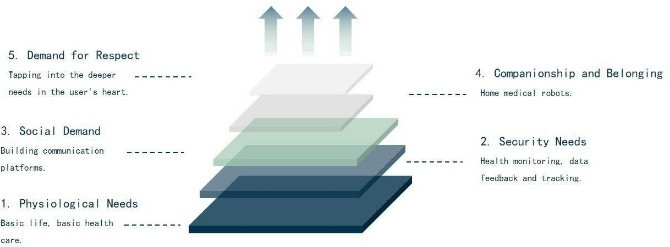
Physiological needs are the most basic necessary for survival. If physiological needs are not met, the lives of older persons are threatened. Therefore, technology supports the basic life and basic medical care of the elderly. Digital health technology uses products or services to solve the fundamental problems of life and medical care for the elderly.
Security needs include personal safety, health protection, moral security, family security and property ownership. Among them, health protection is the foundation of other security needs of older people. In other words, only with a healthy body can older people start other activities. Older adults need health monitoring due to their declining physical functions. Therefore, physiological signs such as heart rate, blood glucose, blood pressure, sleep, etc., can be monitored with data feedback and tracking by using sensing technology to report the physical condition through several critical indicators so that timely treatment and resuscitation can be carried out in dangerous moments to improve the efficiency of medical treatment.
Social needs are higher-level needs, including love, friendship and affection. Compared with physical needs, emotional needs are more detailed. Everyone is in a specific social environment and wants to be cared for. Specific social needs are unavoidable in order to avoid self-enclosure. However, their social needs differ from those of young people; they mostly socialize by organizing activities online and gathering offline, and their channels to broaden their social circle are concentrated offline, and network socialization is just a tool for contacting their feelings. Therefore, the role of community peers in the self-health management of older people is self-evident. Innovative healthcare platforms can connect patients with groups with similar health conditions, promote mutual support and group communication, and increase the social participation of older people. Nowadays, many products have APP services, in which a communication platform can be built for older people, bringing together older people with the same disease who can discuss their daily lives and provide each other with experiences and emotional exchanges.
Respect the need for self-expression of older people. Everyone is unique and has the right to express themselves; of course, older people are no exception. Digitalization has given rise to the development of short videos, and the cost of self-expression has been dramatically reduced, empowering the general public, including older people, with more voice. Used for self-expression is an affirmation of oneself. Digital platforms have brought about a noticeable shift in the daily lives of older adults, providing a platform for those brave enough to express themselves.
Older people build confidence in self-health management, which is conducive to leading a decent life. Therefore, we can make full use of artificial intelligence and sensing technology to enhance the “proactivity” of products, meet the functional needs of users, and even internalize them as part of the bodily functions of the elderly, forming a natural and hidden interaction. In this way, the psychological needs of older people who do not want their physical ageing and defects to show, do not want to be looked at differently by others, and desire to live a decent life like ordinary people can be satisfied.
4.2. Linking Smart Technology to the Needs of Older Adults
In addition to meeting the needs of older people, it is also essential to strengthen the relationship between older people and technology, which helps to enhance their willingness to use innovative products. Therefore, behavioral design is also needed. Through behavioral design, we can stimulate the interest of older people in using innovative products and guide older people who are already using intelligent products to use them more intensively.
In 1930, Harvard psychologist B.F. Skinner created a Skinner box experiment to study how rats respond to rewards. In a box with a control lever, the rats were given food to drop whenever they pushed the lever, a reward that led to the rats quickly learning the skill of pushing the lever. Skinner speculated that if the rewards were designed well, human behavior could be guided by what is now known as Behavioral Design. Professor B.J. Fogg of Stanford University applied behavioral design with computer software and the Internet to provide theoretical support for studying user behavior [31]. Fogg believed that behavior is influenced by motivation, capability cost, and triggers, i.e., the Fogg Behavioral Model (shown below) was produced. The Fogg Behavioral Model shows that the occurrence of behavior needs to satisfy the three critical points of motivation, capacity cost, and triggers, which are favorable conditions for the occurrence of a behavior.
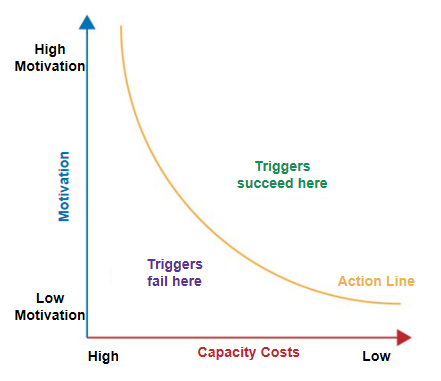
① Increase the motivation to use the product: Motivation can be divided into direct and indirect. The user’s willingness to use this product is low. Suppose we want to fully integrate ageing and digitalization and make digitalization fully integrated into the lives of older people. In that case, we need to start with the people or environment around older people and indirectly influence the willingness of the elderly group to use intelligent products. Recommendations from friends and relatives are an excellent way to gain motivation. Due to the obvious social needs of older people, getting likes and comments from their friends and relatives on technology products will increase their willingness to use them and achieve the purpose of communication and socialization. In addition, the “family” function also makes online socializing more cohesive. Among them, the “regional family” has very regional attributes and can be accurate to the provinces, cities and streets where the elderly users can not only expand offline social networking but also increase the sense of belonging of older people in use.
② Reduce the cost of using digital products: Motivation to meet the factors and the ability to cost are also indispensable.
- Reduce the user’s time cost, i.e., improve the product’s responsiveness and give positive feedback during the waiting process to increase the product’s fault tolerance. Otherwise, older people may perceive that they have made a mistake and thus be demotivated to use the product.
- Reduce learning costs. Intelligent products with clear functional logic and simple interaction may attract many users. For example, in Dou Yin, videos can load automatically, and users can see updated videos by simply sliding up or down. Older people can access their favorite content by simply moving their fingers, and the learning cost is meagre, attracting many elderly users.
③ Increase the triggers to use the product: although the user has generated the motivation to use the product, the capacity cost is not high, but if they need a specific behavior to occur smoothly, the catalyst between the elderly user and the product is also significant, that is the triggers (as shown in the figure below).
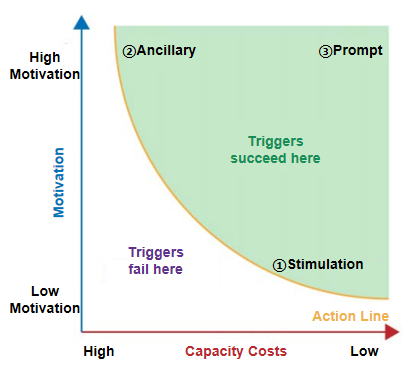
- Reward stimulus is the most common trigger. In the case of a product with low-capacity cost but weak user motivation to use it, reward stimulation affects the user’s usage behavior. Getting unexpected rewards when the user uses the product can increase the user’s sense of surprise about the product and improve the stickiness of using the product. For example, in the case of Pinduoduo, the help of friends can enable users to obtain a sum of money. Users can get rewards through meagre capacity costs, so users who are not too willing to use the product also develop the behavior of using the product.
- Assistance and product fault tolerance. When older users are motivated to use the product, but the ability cost is high, appropriate instructions and guidance can reduce the learning cost to a certain extent. “Kaixin Xiaoxiao Le is one of the few popular games among the elderly. In addition to the friendly image design, more importantly, every new element or character in the game will guide the user on how to play, and when a new activity appears, it will also guide the user on how to get the prize. The prompt signals in the product can also communicate with the user to avoid the situation where the user suddenly encounters a problem that leads to an inability to operate.
5. Conclusion
To focus on technology is to focus on the future. Under the premise of comprehensively judging the situation of population ageing and chronic diseases, an in-depth analysis of the positive and negative impacts of intelligent medical technologies will lay the foundation for finding solutions to innovative medical technologies to better meet the needs of older adults in the future. Elderly health management services and products relying on remote monitoring, artificial intelligence and other information technologies mean there are new ways and contents for elderly health management services. In the self-health management of older adults, we need to pay attention to the different levels of health needs and support them.
Guided by the goal of comprehensively improving the health of the elderly population, Maslow’s hierarchy of needs theory provides theoretical support for the study of self-health management of older adults. Fogg’s behavioral model provides a reference for the design of intelligent health products. This study uniquely combines Maslow’s and Fogg’s theoretical frameworks to explore and address the particular challenges faced by older adults in chronic disease management. By combining insights from behavioral psychology with cutting-edge technology applications, this study provides innovative perspectives for designing inclusive, personalized health management solutions. It is believed that with the continuous acceleration of the process of scientific and technological innovation, the application of science and technology in the field of digital health will become more and more extensive and will continue to meet the multi-level and diversified needs of the elderly chronic disease group, thus improving the efficiency of health management and quality of life of older people [32].
- Z.P. Ren, “China ageing report,” Development Research, 40(2), 22–30, 2023.
- E. Vidal, “Digital literacy program: Reducing the digital gap of the elderly: Experiences and lessons learned,” in 2019 International Conference on Inclusive Technologies and Education, IEEE, San Jose del Cabo, Mexico: 117–1173, 2019, doi:10.1109/CONTIE49246.2019.00030.
- IBM, Smarter planet, 2008.
- M. Chen, “New progress and prospect of smart healthcare in China in 2021,” China Medical News, 36, 6–7, 2021.
- Q. Zeng, X.Y. Gao, S.Z. Bai, “Theory and practice of smart health management,” Chinese Journal of Health Management, 16, 3–6, 2022.[6] H. Wang, Y. Zhao, L. Yu, et al., “A personalized health monitoring system for community-dwelling elderly people in Hong Kong: design, implementation, and evaluation study,” J. Med. Internet Res., vol. 22, p. e19223, 2020.
- H. Wang, Y. Zhao, L. Yu, J. Liu, I.M. Zwetsloot, J. Cabrera, K. L. Tsui, “A personalized health monitoring system for community-dwelling elderly people in Hong Kong: Design, implementation, and evaluation study,” Journal of Medical Internet Research, 22(9), e19223, 2020, doi:10.2196/19223.
- R.P. Searcy, J. Summapund, D. Estrin, J.P. Pollak, A. Schoenthaler, A.B.
Troxel, J.A. Dodson, “Mobile health technologies for older adults with cardiovascular disease: Current evidence and future directions,” Current Geriatrics Reports, 8(1), 31–42, 2019, doi:10.1007/s13670-019-0270-8. - S. Silva, R. Felgueiras, I.C. Oliveira, “Geriatric helper: An mHealth application to support comprehensive geriatric assessment,” Sensors, 18(4), 1285, 2018, doi:10.3390/s18041285.
- S. Yu, Y. Chai, H. Chen, R.A. Brown, S.J. Sherman, J.F. Nunamaker, “Fall detection with wearable sensors: A hierarchical attention-based convolutional neural network approach,” Journal of Management Information Systems, 38(4), 1095–1121, 2021, doi:10.1080/07421222.2021.1990617.
- R. Zhong, P. L.P. Rau, “A mobile phone–based gait assessment app for the elderly: Development and evaluation,” JMIR mHealth and uHealth, 8(5), e14453, 2020, doi:10.2196/14453.
- A. Panarello, N. Tapas, G. Merlino, F. Longo, A. Puliafito, “Blockchain and IoT integration: A systematic survey,” Sensors, 18(8), 2575, 2018, doi:10.3390/s18082575.[12] M. Shakeri, A. Sadeghi-Niaraki, S. M. Choi, et al., “Performance analysis of IoT-based health and environment WSN deployment,” Sensors (Basel), vol. 20, p. 5923, 2020.
- M. Shakeri, A. Sadeghi-Niaraki, S. M. Choi, S.M.R. Islam, “Performance analysis of IoT-based health and environment WSN deployment,” Sensors, 20(20), 5923, 2020, doi:10.3390/s20205923.
- L. Liu, E. Stroulia, I. Nikolaidis, A. Miguel-Cruz, A. Rios Rincon, “Smart homes and home health monitoring technologies for older adults: A systematic review,” International Journal of Medical Informatics, 91, 44–59, 2016, doi:10.1016/j.ijmedinf.2016.04.007.
- J. Rong, X. Ji, X. Fang, M. H. Jee, “Research on material design of medical products for elderly families based on artificial intelligence,” Applied Bionics and Biomechanics, 2022, 1–6, 2022, doi:10.1155/2022/7058477.
- A.M. Fischer, A. Varga-Szemes, M. Van Assen, L.P. Griffith, P. Sahbaee, J.I. Sperl, J.W. Nance, U.J. Schoepf, “Comparison of artificial intelligence–based fully automatic chest CT emphysema quantification to pulmonary function testing,” American Journal of Roentgenology, 214(5), 1065–1071, 2020, doi:10.2214/AJR.19.21572.
- C.L. Walker, M. Kopp, R.M. Binford, C.J. Bowers, “Home telehealth interventions for older adults with diabetes,” Home Healthcare Now, 35(4), 202–210, 2017, doi:10.1097/NHH.0000000000000522.
- L. Klingensmith, L. Knodel, “Mercy virtual nursing: An innovative care delivery model,” Nurse Leader, 14(4), 275–279, 2016, doi:10.1016/j.mnl.2016.05.011.
- N. C. Chi, G. Demiris, “The roles of telehealth tools in supporting family caregivers: Current evidence, opportunities, and limitations,” Journal of Gerontological Nursing, 43(2), 3–5, 2017, doi:10.3928/00989134-20170111-04.
- J. Wu, “Study on the current situation and influencing factors of China’s elderly people’s internet use: Analysis based on CGSS 2017 data,” Scientific Research on Aging, 9(9), 43–58, 2021.
- S.J. Song, Research on digital divide problems and countermeasures for the elderly in Dalian city, Liaoning Normal University, 2021, doi:10.27212/d.cnki.glnsu.2020.001653.
- W.C. Su, Z.P. Lu, Z.X. Wang, “Preserving the dignity of elders’ choices: A conceptual model of autonomous behavior in the use of digital technologies for older adults,” Library Forum, (8), 86–95, 2021.
- Y.L. Wang, L. Z., “Analysing the influencing factors and countermeasures of the digital divide among the elderly in the digital age,” Journalism Probe, 9, 126–128, 2021.
- F. Lin, A study of the digital generation gap in Chinese families in the context of ageing, Shenzhen University, 2018.
- X. Xu, The impact of the internet on the continued socialization of older people, Dongbei University of Finance and Economics, 2013.
- W.P. Zhang, J.H. Fan, “The construction of a social support system for the digital divide in old age,” Scientific Research on Aging, 7(2), 63–70, 2019.
- Z.C. Du, “Revisiting the adherence to a positive view of gerontological education — and discussing the social de-personalization of the individual, life education,” The Seniors University, 5, 22–26, 2009.
- C.X. Huang, “Status, challenges and countermeasures of the digital divide in old age,” People’s Forum, (29), 126–128, 2020.
- B. Lin, “Difficulties and priorities in the governance of digital poverty among the elderly,” People’s Forum, (29), 129–131, 2020.
- B. Yang, D.C. Jin, “The digital divide in the elderly: Manifestations, motivations, and paths to bridging,” Central States Journal, (12), 74–80, 2021.
- A.H. Maslow, Maslow’s humanistic philosophy, Jilin Publishing Group Co., Ltd.: 35–38, 160–168, 2013.
- B. Fogg, “A behavior model for persuasive design,” in Proceedings of the 4th International Conference on Persuasive Technology, ACM, Claremont California USA: 1–7, 2009, doi:10.1145/1541948.1541999.
- H.L. Zhu, “Integrating technology in China to help the elderly: A paradigm shift,” Communication of IIMA, 3, 95–106, 2015.